


About the author: Miruna works in marketing and joined the Future Intelligence Think Tank five months ago. This essay is part of our effort to hear from people outside the expert bubble, the ones using AI every day without building it.
Left and right, everybody seems to have a theory about AI. Some say it’ll kill us all. Others say it’ll leave us jobless, and a whole other crowd is holding on to the hope of universal basic income like it’s the last lifeboat off the Titanic. Scroll for five minutes and you’ll find someone explaining, with charts, exactly how the world ends in 2030.
Some of these people genuinely understand how this stuff works. They know what a large language model is and what “alignment” means, and they have opinions about GPUs. Plenty of the loudest voices are just repeating something they heard somewhere, and from where I’m sitting, it’s hard to tell the two apart. So which group am I in? Do I actually understand how any of this works?
I don’t.
And yet, until recently, I had opinions about AI anyway. Strong ones, sometimes. It took me an embarrassingly long time to notice that none of them were truly mine. One came from a TikTok I watched at 1 a.m., another from a headline I never clicked, and the rest from whoever sounded most certain in the last conversation I was part of. I spend a lot of my time around very smart people who talk about AI for a living, and if you asked me to explain how a chatbot actually comes up with an answer, I would still smile politely and change the subject.
What my AI life looks like
Let me show you my chat history, because I think it says more about the average AI user than any theory ever could:
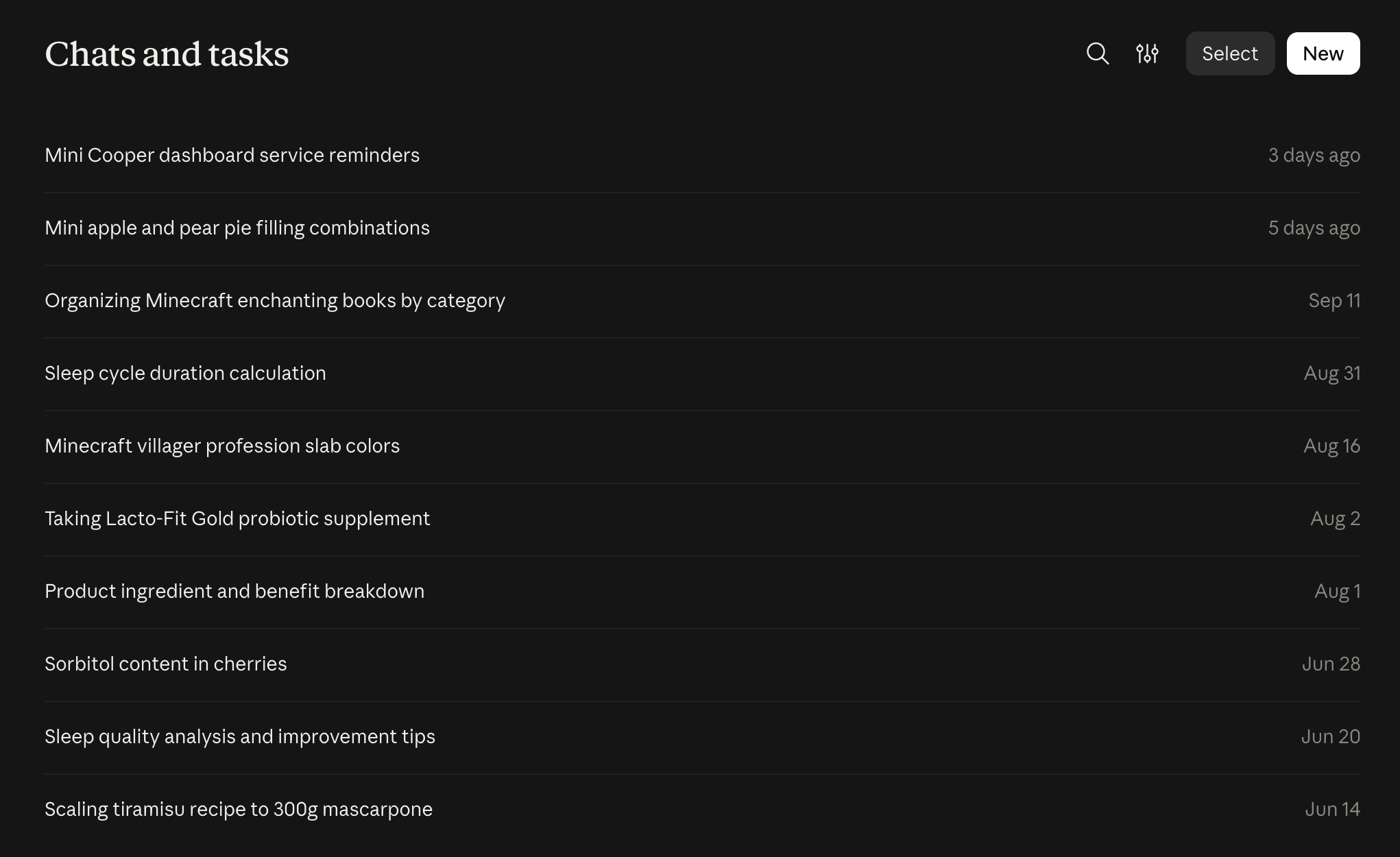
That’s it. That’s the empire. There’s no army of agents waiting for my command, no startup I built over a weekend and no secret plan to bring down society. Just a laptop and a very patient chatbot that has never once judged me for asking about the same supplement four times.
Sure, I use it for work too. It helps me brainstorm when my brain has turned to mush, and it’s very good at turning my 2 a.m. ramblings into something that gets close to a sentence. But that’s about as dramatic as it gets.
And I really don’t think I’m alone. Most of us are fluent AI users and complete AI beginners at the same time. We know exactly how to get a recipe out of a chatbot, and have almost no idea what it remembers of us or when it’s confidently wrong.
Where our opinions come from
So, I went looking for actual numbers and found something I didn’t expect. In 2024, the Pew Research Center asked more than 1,000 AI experts and over 5,000 ordinary Americans what they thought about AI. 56% of the experts said AI would have a positive impact on the country over the next 20 years. Among the public, it was 17%. Almost half of the experts said they were more excited than worried about AI in daily life. For the rest of us, it was 11%.
Read that again, because it messes with everything I assumed. On average, the people who understand AI best are more hopeful about it than the rest of us. That doesn’t mean they’re carefree, and some of the loudest warnings come from inside the industry. But most of the everyday anxiety sits on our side of the divide, and I suspect a lot of it was borrowed rather than earned.
To be clear, I’m not saying the experts are right and we’re being silly. Optimism has blind spots too, especially when your career depends on the thing you’re optimistic about. My point is smaller and more personal: if I’m going to fear something, or be excited about it, I’d rather the feeling be my own.
You have to earn the right to panic
Earning an opinion doesn’t mean becoming an expert. It means doing the small work of understanding the tools already in your life, so that when someone tells you AI will save or destroy the world, you have at least some way of judging whether they’re right.
You can’t push back on something you don’t understand. You can’t ask the right questions about privacy if you don’t know your chatbot remembers things about you, and you can’t spot a confidently wrong answer if you’ve never caught one. Not knowing isn’t a crime. Staying that way is a choice, though, and it’s a choice that leaves the big decisions to someone else.
Here’s where you can start:
Asking the AI to explain itself. What does it remember about you? Where does its information come from? Then checking whether the answers actually hold up.
Testing it on something you know well. Ask it about your own job or hobby and count how often it’s confidently wrong. It’s humbling for both of you.
Reading the settings once. Memory, data sharing, chat history. Ten boring minutes that teach you more than a hundred doom posts.
Following a couple of people who explain AI without trying to sell it or scream about it.
Double-checking anything important, especially health or money advice, with an actual human expert.
None of this will make you an expert. It’ll just make you a slightly less clueless user, and I think that’s exactly where most of us should start.
Let’s meet halfway
Closing the gap isn’t only our job. Researchers at University College London found that many AI researchers hold what’s called a “deficit model” of the public, the assumption that people distrust AI simply because they don’t understand it well enough. As if we’d all fall in line if someone explained it slowly.
But the Pew research also found something both sides share. Around half or more experts and the public said they have little or no authority over how AI is used in their lives, and more than half of each want more control. No amount of AI literacy fixes that on its own. Somebody also has to listen. People like me need to put in the effort to understand these tools, and the people building them need to hear how they actually feel from the kitchen table.
Where that leaves me
Is everybody exaggerating, or are we too uninformed to see what’s coming? I still don’t know, and that’s sort of the point. I’d rather say “I don’t know yet” and go find out than borrow somebody else’s certainty.
That’s actually why I joined Future Intelligence Think Tank a few months ago. Being around engineers, researchers and founders who argue about this stuff in good faith means I no longer have to wonder whether the person explaining AI to me really knows what they’re talking about. It’s cut my research time in half, and while it hasn’t made me an expert, it’s at least a starting point.
As for the dog treats, they were a massive hit. At least someone in this house trusts AI completely. I’d just like to understand it a little better before I do.
So, be honest with me, is your opinion on AI borrowed or earned? And if it’s borrowed, who did you borrow it from? Let me know in the comments!