

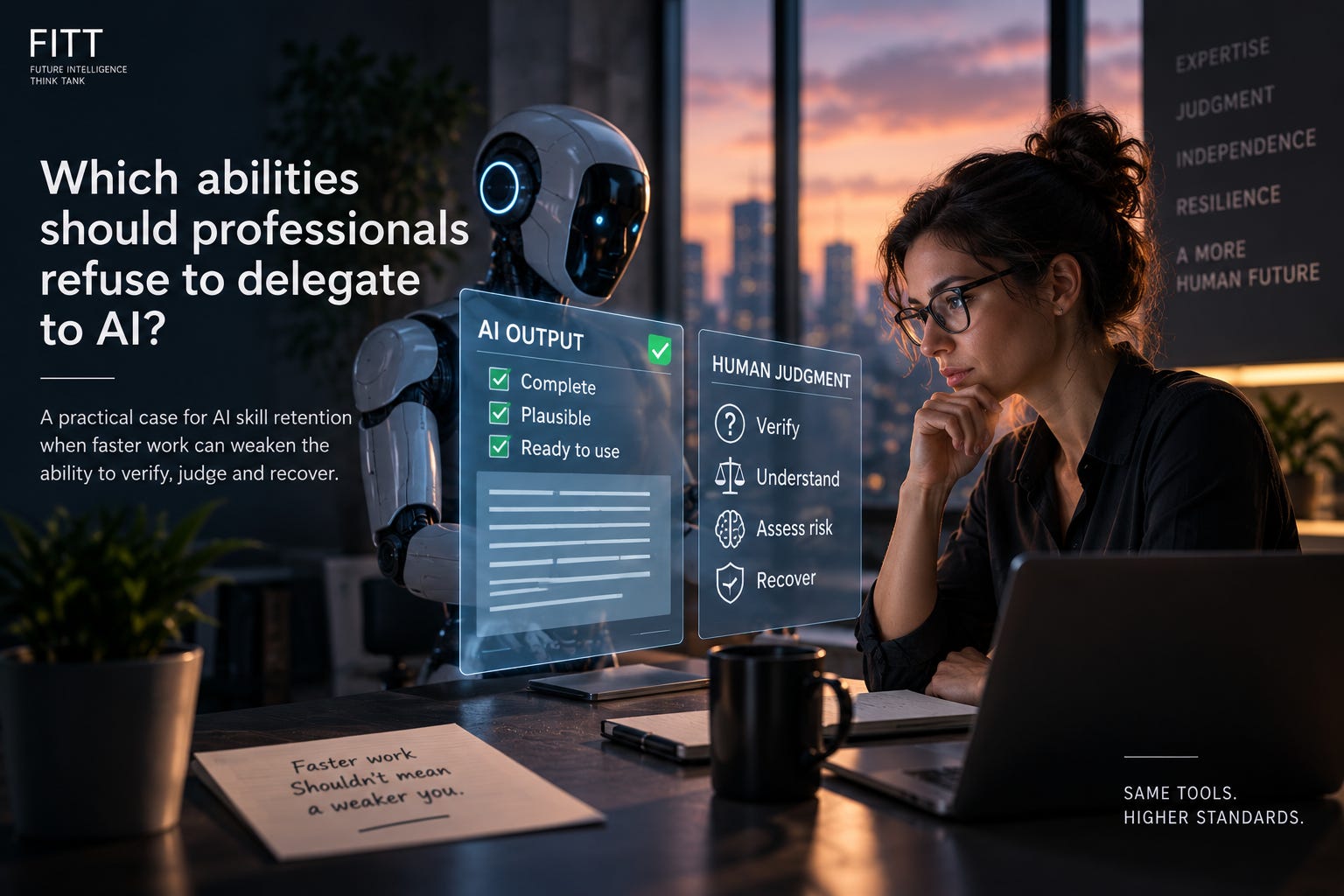
A professional receives an AI generated answer that looks complete, plausible and ready to use.
There is one problem. They cannot explain why it is correct.
That situation is becoming an ordinary part of knowledge work. Developers review generated code. Analysts inspect generated conclusions. Clinicians increasingly work alongside systems that identify patterns or suggest diagnoses.
The obvious question is whether AI improves the result or reduces the time required to produce it. A harder question follows: which abilities still need regular human practice once AI can perform the underlying task?
Organizations need an answer before convenience answers it for them.
The argument emerging from a recent Future Intelligence Think Tank (FITT) discussion is practical. Some professional capabilities should be deliberately preserved, even when using AI is faster. The strongest candidates are the abilities people need to verify AI output, exercise judgment in uncertain situations and recover when automation fails.
That suggests a new management responsibility: AI skill retention.
Efficiency changes what professionals practice
AI can reduce the amount of direct work required to complete a task. That advantage is easy to measure.
The less visible consequence is a change in what the professional repeatedly practices.
A longitudinal study of software engineers by Annie Vella and Kelly Blincoe found that AI coding assistants were changing the balance of engineering work. Participants reported spending less time writing code and more time directing, evaluating and correcting AI output, a category the researchers call supervisory engineering work. Perceived productivity remained high while aspects of developer experience, including cognitive load and flow, worsened for some participants over time.
Another study of 442 developers by Zixuan Feng, Sadia Afroz and Anita Sarma found that GenAI adoption could increase job demands associated with burnout, while supportive resources and positive perceptions could mitigate some of those effects.
These findings complicate a simple productivity calculation.
If a developer writes less code and reviews more generated code, the organization has changed the work. It has also changed the practice through which expertise develops.
That distinction appeared repeatedly in the FITT discussion behind this article. One participant, data engineer Andronic Tudor, argued for deliberately keeping part of the work without AI as practice. His concern was that reviewing generated output does not exercise exactly the same capability as producing the work yourself.
Gheorghe David, Co-Founder and Managing Partner at ASSIST Software, pushed the idea further. Professional expertise has traditionally developed through doing difficult work, making mistakes and building judgment. If AI removes some of that difficulty, organizations may gain immediate productivity while reducing opportunities to develop the expertise they will need later.
This creates a management question that deserves more attention than tool adoption rates:
What should people continue doing themselves because the act of doing it develops a capability the organization still depends on?
Verification requires knowledge that cannot be outsourced completely
The strongest reason to preserve a skill is verification.
A professional cannot reliably supervise an AI system using knowledge they no longer possess.
Software offers an obvious example. Generated code may compile, pass tests and look convincing. A developer still needs enough understanding of architecture, security, edge cases and system behavior to recognize when the solution is locally plausible and globally wrong.
Medicine provides evidence that the problem extends beyond software.
A 2025 observational study examined endoscopists who had begun routinely using AI during colonoscopies. Researchers compared their performance on colonoscopies conducted without AI before and after AI was introduced into their practice. Adenoma detection during those unaided procedures fell from 28.4 percent to 22.4 percent. The authors described the result as evidence of a possible deskilling effect, while also noting the observational design of the study.
A separate experiment involving 27 radiologists examined what happened when readers received incorrect AI suggestions while assessing mammograms. Accuracy fell substantially when the AI recommendation was wrong, including among highly experienced radiologists.
These studies come from specific clinical settings, so their results should not be generalized mechanically to every profession. They still expose an important design problem for AI supported work: supervision depends on the human retaining enough independent capability to challenge the machine.
A review process is valuable only when the reviewer can detect something worth challenging.
Failure reveals which skills still matter
There is another useful way to decide what should remain practiced: imagine the AI disappears.
Which abilities become immediately important?
For some tasks, very little is lost. If AI drafts a routine internal summary and the system becomes unavailable, the cost may be a small delay.
Other tasks are different. A developer may need to debug a production failure when the assistant lacks the required context. An engineer may need to understand why an automated recommendation conflicts with observed system behavior. A clinician may need to make a judgment when the model is unavailable or its recommendation does not fit the patient.
Capabilities required under those conditions cannot exist only as historical knowledge inside the organization.
They need people who still know how to use them.
This is why the FITT discussion repeatedly returned to practice. One suggestion was to rotate professionals through periods of work without AI and assess their understanding of the system itself, not simply the amount of work they shipped.
That idea deserves serious consideration.
Organizations already maintain redundancy in systems they consider important. They test backups, rehearse incident procedures and maintain fallback processes because reliability cannot depend on every component working perfectly.
Human capability deserves similar attention when it is part of the fallback.
A practical test for AI skill retention
Organizations do not need to preserve every manual process. That would sacrifice useful automation and turn skill retention into ritual.
They do need a way to distinguish disposable effort from capability that supports reliable judgment.
A simple test can begin with three questions:
Is this capability necessary to verify AI output? If someone cannot judge the quality of an AI result without the underlying skill, regular practice has operational value.
Will this capability be needed when AI fails or lacks context? Skills that support recovery, escalation and unusual cases should remain available inside the organization.
Does practicing the task develop judgment used elsewhere? Some work teaches more than the task itself. Debugging can develop systems thinking. Writing can sharpen reasoning. Direct analysis can expose assumptions that disappear when the first interpretation arrives preassembled.
A capability that meets one of these conditions deserves examination. A capability that meets all three deserves deliberate protection.
The policy can then become concrete.
Teams might identify a small set of capabilities that must remain practiced, define how often professionals exercise them without AI assistance and include human understanding in performance reviews or technical assessments.
The exact mechanism will differ by profession. The principle is stable: do not let frequency of AI use become the accidental mechanism that decides which human skills survive.
Productivity metrics need a longer horizon
AI adoption is often evaluated through measures such as output, cycle time, cost and adoption.
Those numbers matter. They can also miss capability erosion until the organization needs the capability again.
A team can become faster this quarter while becoming less capable of diagnosing an unusual failure next year. A junior professional can produce stronger work immediately while receiving fewer opportunities to build the judgment expected of a senior professional later.
That creates a delayed cost.
The difficult part is that capability retention can look inefficient in the short term. Asking an engineer to solve some problems without assistance takes longer. Requiring professionals to explain the reasoning behind an AI generated result adds effort. Preserving direct practice means accepting some friction.
The FITT discussion surfaced a useful idea here: some friction may be part of how expertise is maintained.
Organizations therefore need to decide which friction is waste and which friction is training.
AI makes that distinction increasingly important because the easiest workflow will usually favor more delegation. Without an explicit policy, the organization may discover its skill boundary only after crossing it.
The abilities worth protecting
The purpose of a capability retention policy is not to preserve old ways of working for sentimental reasons.
Its purpose is to protect the human capacity that makes AI useful and safe.
A professional who can verify a result can use AI with greater confidence. A professional who understands the underlying system can intervene when automation behaves unexpectedly. A professional who continues exercising judgment can recognize situations that fall outside the assumptions built into the tool.
That leads to a useful principle for AI adoption:
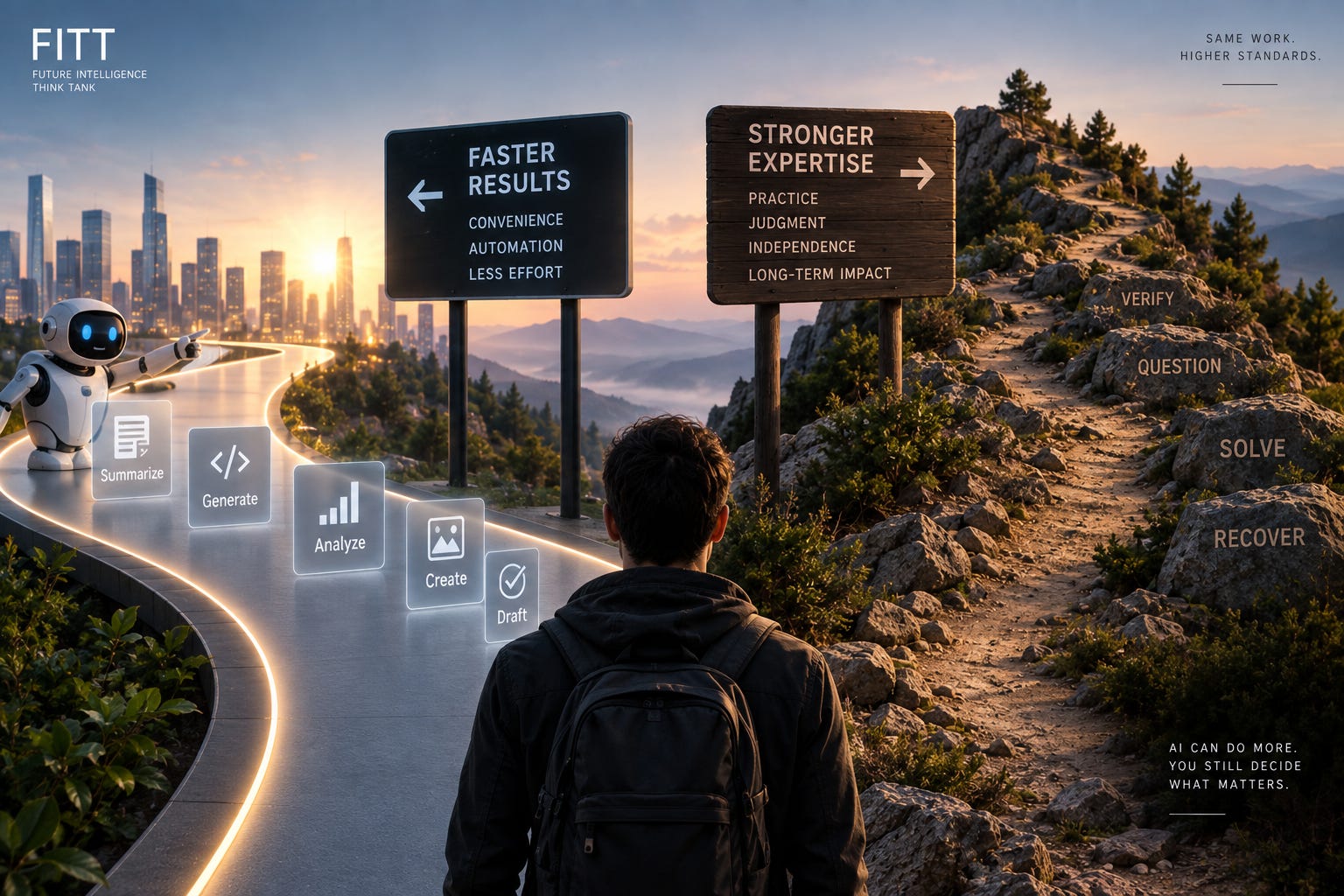
Delegate the work when it improves the system. Preserve the capability when the organization still depends on the human knowing how to judge, challenge or recover that work.
The difficult decision is identifying where that line sits in each profession.
Which part of your work would you continue practicing even if AI could perform it faster?
The Future Intelligence Think Tank brings together executives, specialists and researchers examining questions like this. Join the discussion on LinkedIn.